Store Networks
In-store customer analytics
Choose store analytics from the decisions your team can make. Define visits, zones, queues and transactions, then check data quality and privacy.
In-store customer analytics is useful when a retailer can name the decision a measure will support. An entrance count can help plan staffing, but cannot explain why someone left or identify who returned. Choose the question first, then define what the system must observe.
Match the measure to the decision
| Store question | Useful observation | Limit |
|---|---|---|
| When do visits arrive? | Eligible entries by trading period | Entries are not necessarily distinct shoppers. |
| Which area receives visits? | Movement into a defined zone | A visit does not prove attention or intent. |
| Where does service slow? | Queue length or waiting events | A reading alone does not explain the cause. |
| Do visits coincide with purchases? | Eligible visits and qualifying transactions for the same period | The ratio does not identify which visitor bought. |
Label each figure as crossings, visits, observed paths, transactions or identified customers. Keep those definitions consistent across periods and stores.
Match the store question to a useful observation and its limit
- When do visits arrive?Useful observation: eligible entries by trading period. Limit: entries are not necessarily distinct shoppers.
- Which area receives visits?Useful observation: movement into a defined zone. Limit: a visit does not prove attention or intent.
- Where does service slow?Useful observation: queue length or waiting events. Limit: a reading alone does not explain the cause.
- Do visits coincide with purchases?Useful observation: eligible visits and qualifying transactions for the same period. Limit: the ratio does not identify which visitor bought.
Build a staged measurement plan
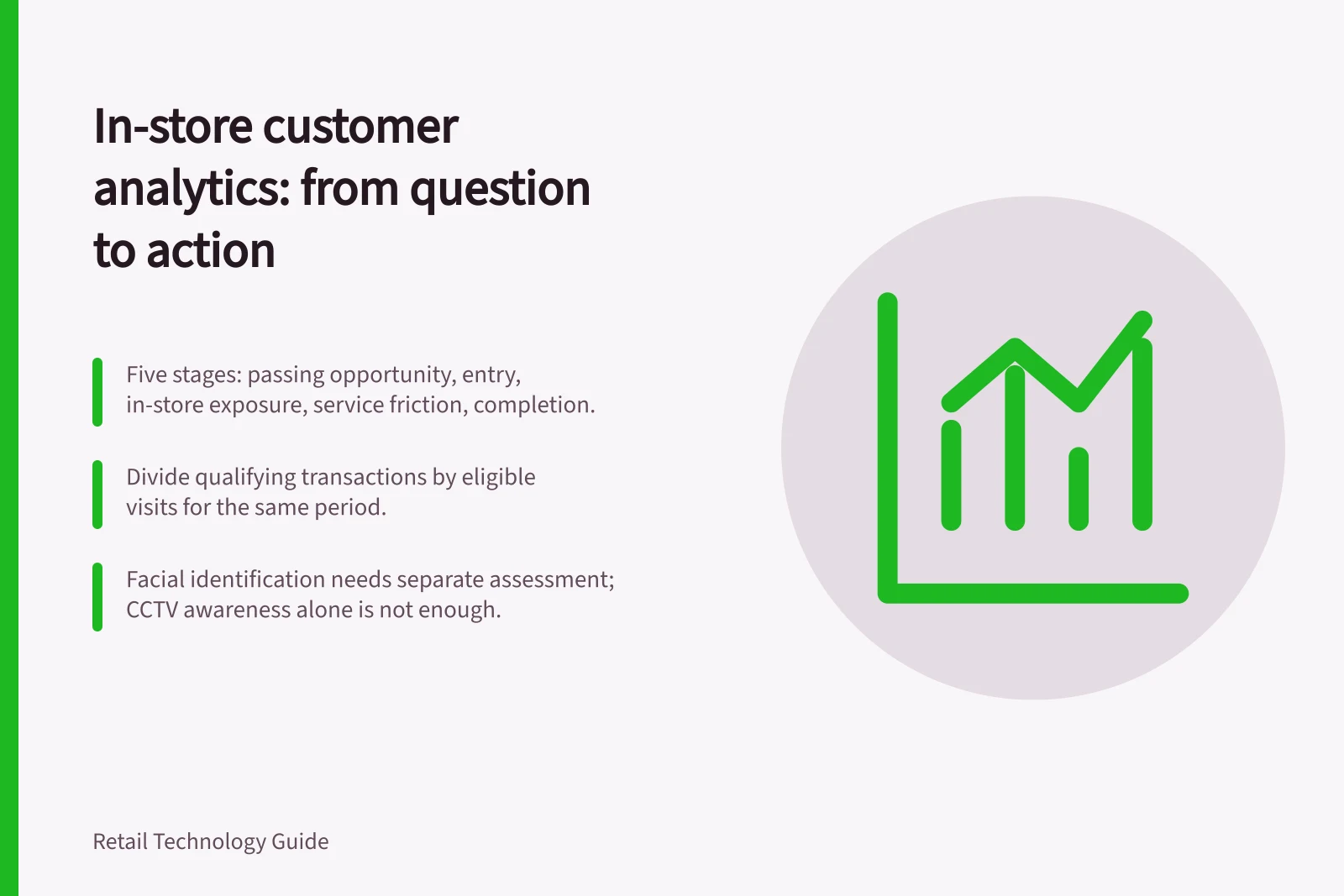
A store measurement plan can follow five stages: passing opportunity, store entry, in-store exposure, service friction and commercial completion. This separates the chance to enter from an actual entry, an area visit, a queue condition and a purchase. These are not interchangeable signs of customer activity.
For each stage, define the event, the tool that records it and the population it represents. A funnel is useful when it shows where opportunity may be gained or lost. It becomes misleading if a later-stage count is divided by a number from a different place, period or population.
Five stages of a store measurement plan
- Passing opportunityDefine the chance to enter.
- Store entryRecord an actual entry.
- In-store exposureMeasure movement into a defined zone.
- Service frictionRecord queue length or waiting events.
- Commercial completionLink eligible visits and qualifying transactions for the same period.
Define the store boundary
Mark every entrance and exit, shared doorway, service area and relevant zone. Decide how to treat staff, deliveries, people who leave and return, and movement between adjoining spaces. A counter over one doorway describes that doorway unless coverage of the other routes is established.
For a store-level purchase ratio, divide qualifying transactions by eligible visits for the same period. Decide how returns, cancellations and non-selling transactions are handled. One transaction can involve several shoppers; one shopper can make several transactions. Call the result a transaction-to-visit ratio, not the proportion of individual visitors who bought.
Path and dwell measures require coverage beyond an entrance counter. Ask where a path becomes uncertain and whether staff movements are excluded. A zone visit shows that someone entered a measured area. It does not show what they read, considered or bought because of that visit.
Store boundary decisions
- Mark every entrance and exit, shared doorway, service area and relevant zone.
- Decide how to treat staff, deliveries, people who leave and return, and movement between adjoining spaces.
- Establish coverage of all routes before describing a store-level count.
- For a store-level purchase ratio, divide qualifying transactions by eligible visits for the same period.
- Decide how returns, cancellations and non-selling transactions are handled.
- Call the result a transaction-to-visit ratio, not the proportion of individual visitors who bought.
- Ask where a path becomes uncertain and whether staff movements are excluded.
- Remember a zone visit does not show what was read, considered or bought because of that visit.
Connect the report to an action
Put an owner and a possible response beside each proposed metric. If a queue grows, who can open another till? If visits to a department fall, who checks the layout, stock and trading conditions? A report with no available response has limited operational value.
When comparing periods, record roster levels, promotions, layout changes, outages and unusual events. Review the underlying counts before interpreting a rate: a higher transaction-to-visit ratio can result from fewer counted visits.
Test a store change before expanding
A bounded trial can assess a proposed layout, display or merchandising change in a small set of pilot stores. Compare them with control locations that continue business as usual. The controls give a reference for interpreting what happened during the same period.
Track the measures relevant to the change, such as dwell, engagement or path data, against the control locations. Seek statistically meaningful results before extending the test to other locations. The evidence can support scaling the change, adjusting it or shelving it.
Test a store change before expanding
- Select pilot storesChoose a small set of stores for the proposed layout, display or merchandising change.
- Keep controlsCompare with control locations that continue business as usual.
- Track relevant measuresUse measures such as dwell, engagement or path data against the controls.
- Seek meaningful resultsCheck for statistically meaningful results before extending the test.
- Decide next stepScale, adjust or shelve the change based on the evidence.
Check collection and trial the measure
Trace data from capture to deletion. Ask whether the device processes or retains images, creates a persistent identifier, or links observations to loyalty or transaction records. An aggregate dashboard does not establish that the underlying data is de-identified.
In Australia, the Australian Privacy Principles apply where the Privacy Act covers the organisation and the information is personal information. Coverage depends on the organisation. State or territory surveillance laws may also apply.
Facial identification calls for a separate assessment. Awareness of CCTV alone does not explain biometric processing.
Trial one question in a defined location. For detailed sensor-versus-manual validation, see the supporting article. Keep a measure only if its reliability and the store's ability to act on it justify its collection and upkeep. A result in one layout does not establish performance in another.
Where the Privacy Act covers an organisation and recorded images are personal information, the Office of the Australian Information Commissioner says people must be told their image may be captured before recording. The organisation must keep recorded personal information secure and destroy or de-identify it when it is no longer needed.
Privacy and data collection checks
- In Australia, the Australian Privacy Principles apply where the Privacy Act covers the organisation and the information is personal information.
- Coverage depends on the organisation.
- State or territory surveillance laws may also apply.
- Facial identification calls for a separate assessment.
- Awareness of CCTV alone does not explain biometric processing.
- Where the Privacy Act covers an organisation and recorded images are personal information, people must be told their image may be captured before recording.
- Keep recorded personal information secure.
- Destroy or de-identify recorded personal information when it is no longer needed.
In this guide
- Footfall counts versus identified customer journeysUnderstand the difference between store entry counts, observed paths and journeys linked to customer records before choosing a measure.
- Evaluating queue measurement technologyCompare queue counts, sensor estimates and ticket timestamps by what they measure, then check boundaries and staff response in the store.
- Reviewing privacy implications of store sensors in AustraliaTrace what store sensors capture, retain and share. Check Australian privacy coverage, notice, de-identification and facial-recognition risks.
- Comparing sensor readings with manual observationsSet matching event rules and observation windows, reconcile missed or extra counts, and report uncertainty before relying on store sensor data.