Inventory Visibility
Part of RFID and retail inventory visibility
RFID versus barcode tracking in stores
Compare RFID and barcode tracking by capture workflow, item identification, exceptions and the store task each method must support.
Start with the unit the store needs to confirm. Barcode capture suits work where a person handles each item and presents its code; RFID suits counts or defined read points where multiple tagged products need identification without line of sight. Choose by the required identification detail, exceptions and operating effort for the task.
Compare the capture methods
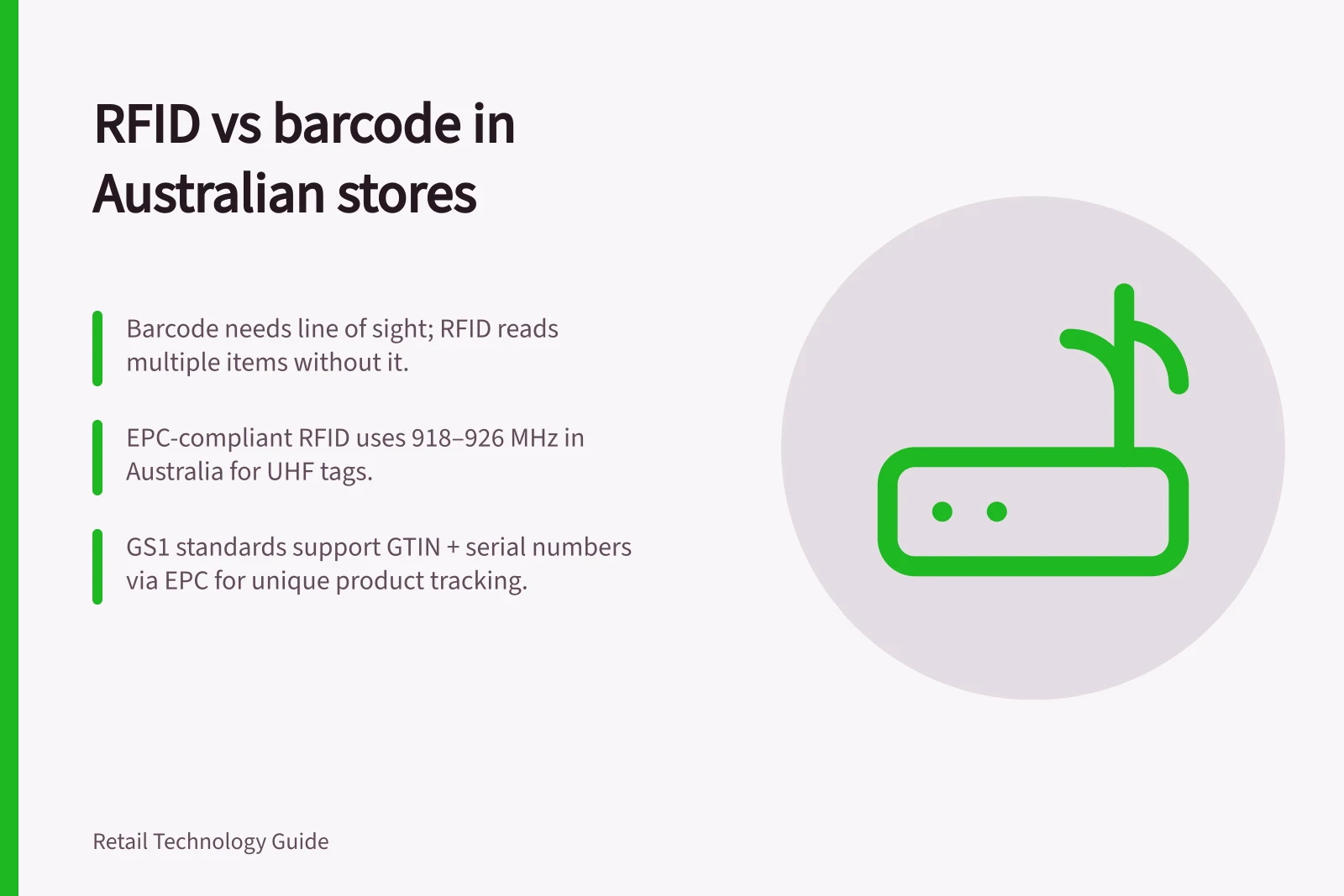
A barcode needs to be presented to a suitable scanner. An RFID reader can capture multiple tagged products without line of sight; GS1 describes thousands of products being identified simultaneously in a single pass. A read confirms tag detection, while the store’s systems and processes must interpret location and stock state.
Examples of barcode formats include EAN-13, UPC, GS1-128, Data Matrix and QR Code. A common retail GTIN identifies a product type; additional encoded data can distinguish an individual item, including through serial numbers in more complex GS1 linear symbols, if the scanner and software support it.
GS1 maintains the EPC standard, and its EPC Tag Data Standard (TDS) specifies EPC data formats and encodings. An EPC identifies a product’s GTIN plus a serial number for each product instance; EPC-compliant tags and readers are designed to interoperate.
In Australia, the standard UHF frequency range for EPC-enabled RFID is 918–926 MHz. A barcode still needs to be on the label when EPC/RFID is used.
Match capture to the task
If a person can handle each item and present its code, barcode capture provides a direct way to confirm that item. If a count involves many tagged products or labels that are not in line of sight, RFID can capture multiple items in a pass; GS1 describes unique EPCs on RAIN RFID tags as readable at extremely high rates and well in excess of 10 metres, depending on products and surroundings.
At receiving, a carton barcode can confirm the carton identifier without confirming every unit inside. Reading tagged units can provide more granular evidence when expected identifiers are reconciled with the goods; either method needs a process for missing, extra or damaged items.
At checkout, staff already handling each product may gain little from changing the capture method unless the transaction and exception process improves. The barcode remains on the label in an EPC/RFID setup, providing a barcode route where checkout or trading partners require it.
RFID readability can be affected by metal, foils and water-based liquids, as well as close proximity between tags. Use one RFID tag per product and consider readability in the sales floor, backroom, displays, lockup and case pack when choosing placement.
For either method, reconcile missed or unexpected capture against the expected goods and correct the stock record manually where needed. Barcode workflows depend on label access, print quality and scanning time; RFID workflows need attention to tag placement, unexpected reads and event processing.
Compare the full operating cost
For barcode capture, account for labels, encoding and printing, scanners, software, staff time and training. For RFID, account for tags and encoding, readers, software changes, staff time, training and exception handling.
Include damaged labels, missing tags, returns and cancelled sales in the operating cost of the chosen method. RFID may reduce labour for manual scans and repetitive scanning, but the store still needs to account for its own implementation and ongoing costs.
Ask suppliers to demonstrate both methods on the same product range and task. Record elapsed time, correctly identified units, missed units, unexpected units and manual corrections, then check the stock record separately after sales and returns have been applied.
A store may use barcodes for transactions and RFID for selected inventory work.